Read the Following Statements: Int a = 5; Int B = 3; Int C = 7; B = a; a = C; C = B;
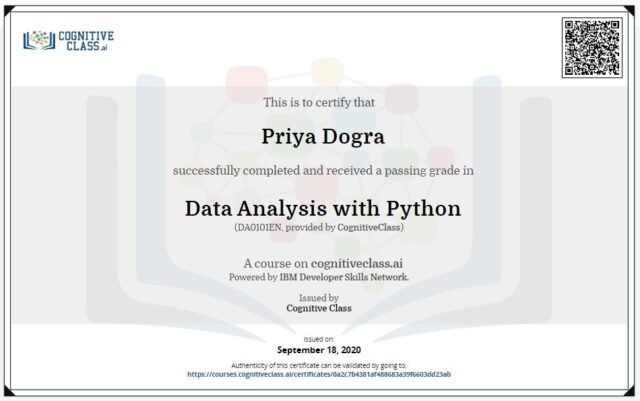
Enroll Here: Data Assay with Python
Module 1 – Introduction
Question 1: What does CSV stand for ?
- Comma Separated Values
- Car Sold values
- Car State values
- None of the higher up
Question 2: In the data ready what represents an aspect or feature?
- Row
- Column
- Each element in the data ready
Question 3: What is another name for the variable that we desire to predict?
- Target
- Feature
- Dataframe
Question iv: What is the control to display the first five rows of a dataframe df?
- df.head()
- df.tail()
Question v: what control do you utilise to go the data type of each row of the dataframe df?
- df.dtypes
- df.caput()
- df.tail()
Question 6: How do you go a statistical summary of a dataframe df?
- df.describe()
- df.caput()
- df,tails()
Question 7: If yous use the method describe() without changing whatever of the arguments you volition get a statistical summary of all the columns of blazon object?
- Faux
- True
Module ii – Data Wrangling
Question 1: Consider the dataframe "df" what is the event of the following operation df['symbolling'] = df['symbolling'] + i?:
- Every chemical element in the column "symbolling" volition increase by one
- Every element in the row "symbolling" will increase by i
- Every element in the dataframe will increase by one
Question 2: Consider the dataframe "df", what does the command df.rename(columns={'a':'b'}) modify almost the dataframe "df"
- rename cavalcade "a" of the dataframe to "b"
- rename the row "a" to "b"
- nothing as you must set the parameter "inplace =True "
Question three: Consider the dataframe "df" , what is the consequence of the post-obit operation df['price'] = df['price'].astype(int) ?
- convert or bandage the row 'price' to an integer value
- convert or cast the column 'cost' to an integer value
- convert or cast the entire dataframe to an integer value
Question 4: Consider the column of the dataframe df['a']. The colunm has been standardized. What is the standard deviation of the values, i.e the outcome of applying the following operation df['a'].std() :
- 1
- 0
- iii
Question 5: Consider the column of the dataframe df['Fuel'], with 2 values 'gas' and' diesel'. What will exist the proper noun of the new colunms pd.get_dummies(df['Fuel']) ?
- ane and 0
- Just diesel
- Merely gas
- Gas and diesel fuel
Question half dozen: What are the values of the new columns from part 5 a)
- 1 and 0
- Merely diesel
- Just gas
- Gas and diesel
Module 3 – Exploratory Information Analysis
Question i: Consider the dataframe "df". Which method provides the summary statistics?
- df.describe()
- df.head()
- df.tail()
- df.summary()
Question ii: Consider the post-obit dataframe:
df_test = df['torso-fashion', 'cost']
The following operations is applied:
df_grp = df_test.groupby(['torso-style'], as_index=Simulated).mean()
What are resulting values of df_grp['cost']:
- The average price for each torso mode
- The average price
- The average body manner
Question 3: Correlation implies causation :
- False
- True
Question four: What is the minimum possible value of Pearson's Correlation :
- 1
- -100
- -1
Question v: What is the Pearson correlation between variables X and Y, if Ten=Y:
- -1
- 1
- 0
- X
- Y
Module iv – Model Development
Question i: Let X be a dataframe with 100 rows and 5 columns, permit y exist the target with 100 samples,bold all the relevant libraries and information accept been imported, the following line of code has been executed:
LR = LinearRegression()
LR.fit(Ten, y)
yhat = LR.predict(Ten)
How many samples does yhat contain :
- five
- 500
- 100
- 0
Question 2: What value of R^2 (coefficient of determination) indicates your model performs all-time ?
- -100
- -1
- 0
- 1
Question 3: What statement is truthful almost Polynomial linear regression
- Polynomial linear regression is not linear in any way
- Although the predictor variables of Polynomial linear regression are not linear the human relationship between the parameters or coefficients is linear.
- Polynomial linear regression uses wavelets
Question iv: The larger the mean square error, the meliorate your model has performed
- False
- True
Question 5: Assume all the libraries are imported, y is the target and X is the features or dependent variables, consider the following lines of code:
Input = [('scale', StandardScaler()), ('model', LinearRegression())]
pipe = Pipeline(Input)
pipe.fit(X,y)
ypipe = pipe.predict(X)
What take we just done in the above code?
- Polynomial transform, Standardize the information, then perform a prediction using a linear regression model
- Standardize the information, and so perform prediction using a linear regression model
- Polynomial transform then Standardize the data
Module 5 – Model Evaluation:
Question 1: In the following plot, the vertical access shows the mean square error andthe horizontal axis represents the order of the polynomial. The cherry-red line represents the training error the blue line is the test fault. What is the all-time order of the polynomial given the possible choices in the horizontal axis?
- 2
- eight
- 16
Question two: What is the use of the "train_test_split" office such that 40% of the data samples will be utilized for testing, the parameter "random_state" is ready to naught, and the input variables for the features and targets are_data, y_data respectively.
- train_test_split(x_data, y_data, test_size=0, random_state=0.four)
- train_test_split(x_data, y_data, test_size=0.4, random_state=0)
- train_test_split(x_data, y_data)
Question three: What is the output of cross_val_score(lre, x_data, y_data, cv=ii)?
- The predicted values of the examination data using cross validation.
- The boilerplate R^2 on the test data for each of the two folds
- This function finds the free parameter blastoff
Question 4: What is the lawmaking to create a ridge regression object "RR" with an alpha term equal x
- RR=LinearRegression(alpha=10)
- RR=Ridge(alpha=10)
- RR=Ridge(alpha=1)
Question 5: What dictionary value would nosotros use to perform a grid search for the following values of alpha: i,10, 100. No other parameter values should be tested
- alpha=[ane,10,100]
- [{'alpha': [1,ten,100]}]
- [{'alpha': [0.001,0.1,1, 10, 100, 1000,10000,100000,100000],'normalize':[True,Fake]} ]
Data Analysis with Python Concluding Exam Answers
Question 1: Question 1: What does the following command do:
df.dropna(subset=["toll"], centrality=0)
- Driblet the "non a number" from the cavalcade toll
- Drib the row cost
- Rename the data frame price
Question 2: How would you provide many of the summery statistics for all the columns in the dataframe "df":
- df.describe(include = "all")
- df.head()
- type(df)
- df.shape
Question 3: How would y'all notice the shape of the dataframe df
- df.describe()
- df.caput()
- type(df)
- df.shape
Question iv: What task does the post-obit command to df.to_csv("A.csv") perform
- change the name of the column to "A.csv"
- load the data from a csv file chosen "A" into a dataframe
- Save the dataframe df to a csv file called "A.csv"
Question 5: What job does the following line of code perform:
df['peak-rpm'].replace(np.nan, 5,inplace=True)
- supplant the non a number values with 5 in the column 'peak-rpm'
- rename the column 'peak-rpm' to v
- add 5 to the data frame
Question 6: What task does the following line of lawmaking perform:
df['peak-rpm'].replace(np.nan, 5,inplace=True)
- replace the non a number values with five in the column 'peak-rpm'
- rename the column 'superlative-rpm' to 5
- add together 5 to the data frame
Question 7: How do you "one hot encode" the cavalcade 'fuel-blazon' in the dataframe df
- pd.get_dummies(df["fuel-type"])
- df.hateful(["fuel-type"])
- df[df["fuel-type"])==one ]=1
Question 8: What does the vertical axis in a scatter plot represent
- contained variable
- dependent variable
Question 9: What does the horizontal axis in a besprinkle plot stand for
- contained variable
- dependent variable
Question x: If we accept ten columns and 100 samples how large is the output of df.corr()
- 10 10 100
- 10 x 10
- 100×100
- 100×100
Question 11: what is the largest possible chemical element resulting in the post-obit operation "df.corr()"
- 100
- 1000
- ane
Question 12: if the Pearson Correlation of two variables is cipher:
- the 2 variable have zero hateful
- the two variables are not correlated
Question 13: if the p value of the Pearson Correlation is 1:
- the variables are correlated
- the variables are not correlated
- none of the above
Question fourteen: What does the following line of code do: lm = LinearRegression()
- fit a regression object lm
- create a linear regression object
- predict a value
Question 15: If the predicted role is:
Yhat = a + b1 X1 + b2 X2 + b3 X3 + b4 X4
The method is
- Polynomial Regression
- Multiple Linear Regression
Question 16: What steps exercise the following lines of code perform:
Input=[('calibration',StandardScaler()),('model',LinearRegression())]
pipe=Pipeline(Input)
pipe.fit(Z,y)
ypipe=piping.predict(Z)
- Standardize the data, then perform a polynomial transform on the features Z
- find the correlation between Z and y
- Standardize the data, and then perform a prediction using a linear regression model using the features Z and targets y
Question 17: What is the maximum value of R^2 that can be obtained
- 10
- 1
- 0
Question xviii: We create a polynomial feature every bit follows "PolynomialFeatures(caste=2)", what is the order of the polynomial
- 0
- 1
- 2
Question 19: You have a linear model the average R^2 value on your training information is 0.5, you perform a 100th order polynomial transform on your data then use these values to train some other model, your boilerplate R^two is 0.99 which annotate is correct
- 100-th society polynomial volition work improve on unseen data
- You should always employ the simplest model
- the results on your preparation data is not the best indicator of how your model performs, you should use your test data to get a beter idea
Question twenty:Y'all train a ridge regression model, yous get a R^2 of 1 on your training data and you go a R^2 of 0 on your validation data, what should you do:
- Nada your model performs flawlessly on your test data
- your model is nether plumbing equipment perform a polynomial transform
- your model is overfitting, increment the parameter alpha
Source: https://priyadogra.com/data-analysis-with-python-cognitive-class-answers/
0 Response to "Read the Following Statements: Int a = 5; Int B = 3; Int C = 7; B = a; a = C; C = B;"
Post a Comment