Herecwe Go Again Creation Trevor Hall
For more 3.5 billion years, living organisms have thrived, multiplied and diversified to occupy every ecosystem on World. The flip side to this explosion of new species is that species extinctions have too always been part of the evolutionary life cycle.
But these two processes are not always in step. When the loss of species speedily outpaces the germination of new species, this balance can be tipped enough to elicit what are known as "mass extinction" events.
A mass extinction is usually defined every bit a loss of about three quarters of all species in beingness beyond the entire Earth over a "curt" geological period of fourth dimension. Given the vast amount of fourth dimension since life beginning evolved on the planet, "short" is defined equally anything less than ii.eight million years.
Since at least the Cambrian period that began around 540 million years ago when the diversity of life kickoff exploded into a vast array of forms, merely five extinction events have definitively met these mass-extinction criteria.
These and so-chosen "Big Five" accept become part of the scientific benchmark to determine whether human beings have today created the conditions for a sixth mass extinction.
The Big Five
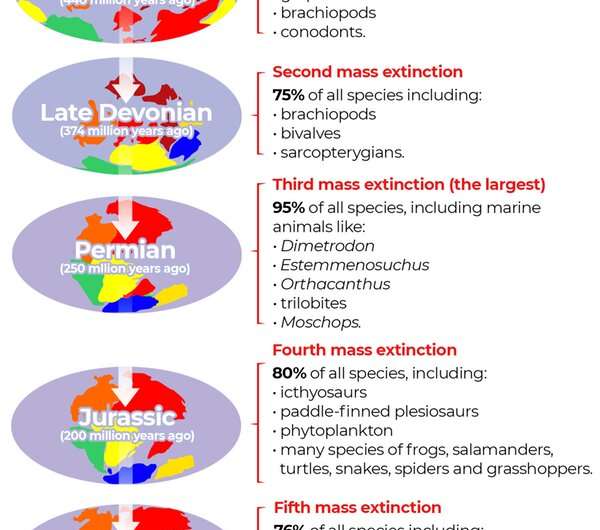
These five mass extinctions have happened on average every 100 million years or so since the Cambrian, although there is no detectable design in their particular timing. Each outcome itself lasted between 50 thousand and ii.76 million years. The first mass extinction happened at the end of the Ordovician period about 443 one thousand thousand years ago and wiped out over 85% of all species.
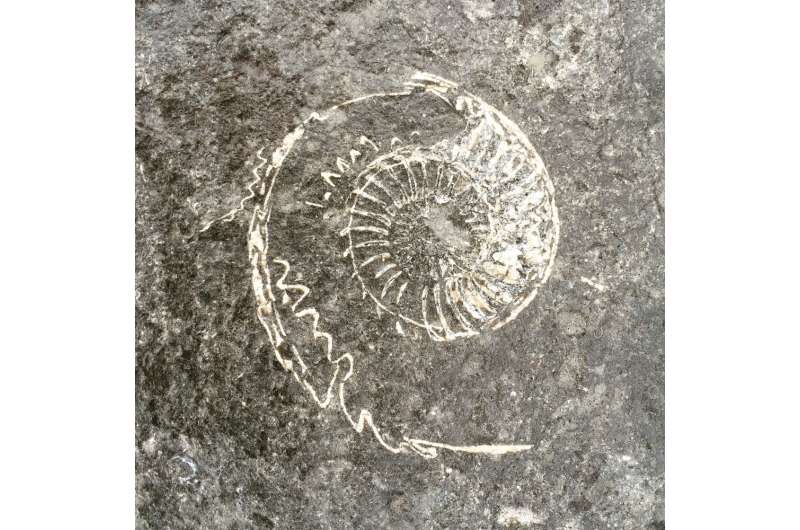
The Ordovician event seems to take been the consequence of 2 climate phenomena. First, a planetary-calibration period of glaciation (a global-scale "ice age"), then a rapid warming menstruum.
The 2d mass extinction occurred during the Belatedly Devonian period effectually 374 1000000 years ago. This affected around 75% of all species, about of which were bottom-domicile invertebrates in tropical seas at that time.
This period in Earth'south past was characterized by high variation in sea levels, and quickly alternating conditions of global cooling and warming. Information technology was also the time when plants were starting to have over dry out land, and there was a drib in global CO2 concentration; all this was accompanied by soil transformation and periods of low oxygen.
The tertiary and most devastating of the Big Five occurred at the finish of the Permian period around 250 meg years ago. This wiped out more 95% of all species in beingness at the time.
Some of the suggested causes include an asteroid bear upon that filled the air with pulverized particle, creating unfavorable climate conditions for many species. These could accept blocked the sun and generated intense acrid rains. Some other possible causes are still debated, such as massive volcanic activity in what is today Siberia, increasing body of water toxicity acquired by an increment in atmospheric CO₂, or the spread of oxygen-poor water in the deep ocean.
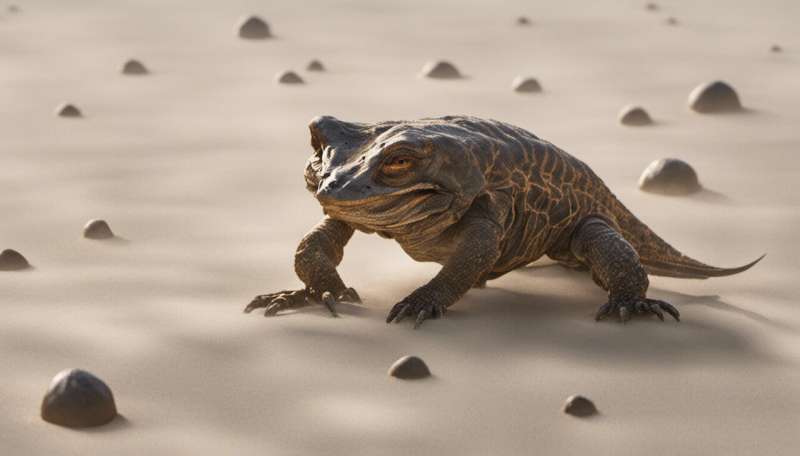
Fifty million years later the bully Permian extinction, about lxxx% of the globe'south species again went extinct during the Triassic event. This was possibly acquired by some colossal geological activity in what is today the Atlantic Ocean that would have elevated atmospheric CO₂ concentrations, increased global temperatures, and acidified oceans.
The concluding and probably most well-known of the mass-extinction events happened during the Cretaceous period, when an estimated 76% of all species went extinct, including the not-avian dinosaurs. The demise of the dinosaur super predators gave mammals a new opportunity to diversify and occupy new habitats, from which homo beings eventually evolved.
The most likely cause of the Cretaceous mass extinction was an extraterrestrial impact in the Yucatán of modern-day Mexico, a massive volcanic eruption in the Deccan Province of modern-day westward-primal Bharat, or both in combination.
Is today'south biodiversity crisis a 6th mass extinction?
The Globe is currently experiencing an extinction crisis largely due to the exploitation of the planet by people. But whether this constitutes a sixth mass extinction depends on whether today's extinction rate is greater than the "normal" or "background" rate that occurs between mass extinctions.
This background rate indicates how fast species would be expected to disappear in absence of human endeavor, and it's by and large measured using the fossil record to count how many species died out between mass extinction events.
The about accepted background rate estimated from the fossil tape gives an average lifespan of virtually one million years for a species, or ane species extinction per million species-years. Only this estimated rate is highly uncertain, ranging betwixt 0.1 and ii.0 extinctions per million species-years. Whether we are now indeed in a 6th mass extinction depends to some extent on the true value of this rate. Otherwise, it's hard to compare Earth's situation today with the past.
In contrast to the the Large Five, today's species losses are driven by a mix of direct and indirect human activities, such as the destruction and fragmentation of habitats, direct exploitation like fishing and hunting, chemical pollution, invasive species, and human being-caused global warming.
If we use the aforementioned approach to approximate today'due south extinctions per million species-years, we come up up with a rate that is between ten and x,000 times higher than the background charge per unit.
Even considering a conservative background rate of ii extinctions per million species-years, the number of species that have gone extinct in the concluding century would take otherwise taken betwixt 800 and ten,000 years to disappear if they were merely succumbing to the expected extinctions that happen at random. This lonely supports the notion that the Earth is at least experiencing many more than extinctions than expected from the groundwork rate.
It would likely take several millions of years of normal evolutionary diversification to "restore" the Earth's species to what they were prior to human beings apace changing the planet. Amongst land vertebrates (species with an internal skeleton), 322 species have been recorded going extinct since the year 1500, or well-nigh 1.two species going extinction every two years.
If this doesn't sound like much, it'south important to remember extinction is always preceded past a loss in population abundance and shrinking distributions. Based on the number of decreasing vertebrate species listed in the International Union for Conservation of Nature's Ruby List of Threatened Species, 32% of all known species across all ecosystems and groups are decreasing in abundance and range. In fact, the Earth has lost most threescore% of all vertebrate individuals since 1970.
Australia has one of the worst recent extinction records of any continent, with more than than 100 species of vertebrates going extinct since the outset people arrived over fifty one thousand years ago. And more than 300 fauna and 1,000 plant species are now considered threatened with imminent extinction.
Although biologists are still debating how much the current extinction rate exceeds the background rate, fifty-fifty the most bourgeois estimates reveal an exceptionally rapid loss of biodiversity typical of a mass extinction issue.
In fact, some studies show that the interacting conditions experienced today, such as accelerated climate change, changing atmospheric composition acquired by human industry, and aberrant ecological stresses arising from human being consumption of resources, define a perfect tempest for extinctions. All these weather condition together indicate that a sixth mass extinction is already well under way.
This article is republished from The Conversation nether a Creative Commons license. Read the original article.
Citation: What is a 'mass extinction' and are we in i now? (2019, Nov thirteen) retrieved 22 April 2022 from https://phys.org/news/2019-xi-mass-extinction.html
This document is subject to copyright. Apart from any off-white dealing for the purpose of individual report or research, no part may be reproduced without the written permission. The content is provided for information purposes only.
Source: https://phys.org/news/2019-11-mass-extinction.html
0 Response to "Herecwe Go Again Creation Trevor Hall"
Post a Comment