Why Did the Decline of the Coal Stop Around 1960 and Then We Increased Its Use Again
At Aberthaw Power Station on the coast of Due south Wales, Tom Glover examines a dwindling pile of coal, for what may exist the terminal time. At its height in 2013, the coal-fired power plant generated enough electricity to continue the lights on in 3m homes every yr.
But today — after almost half a century in operation — all is quiet. The furnaces are not running, there are no plumes from the smokestack, and in that location is no soot resting on the vehicles in the car park. The constitute is but trying to utilise upward its remaining stockpile of coal earlier it closes for good early side by side yr.
"You exercise become nostalgic, definitely," says Mr Glover, who is the UK head of German utility company RWE, which owns Aberthaw, and who was once responsible for ownership coal for the found. "This was my favourite power station," he says, pointing out the conveyor belts that move coal around the constitute. "It'due south a place with a lot of engineering."
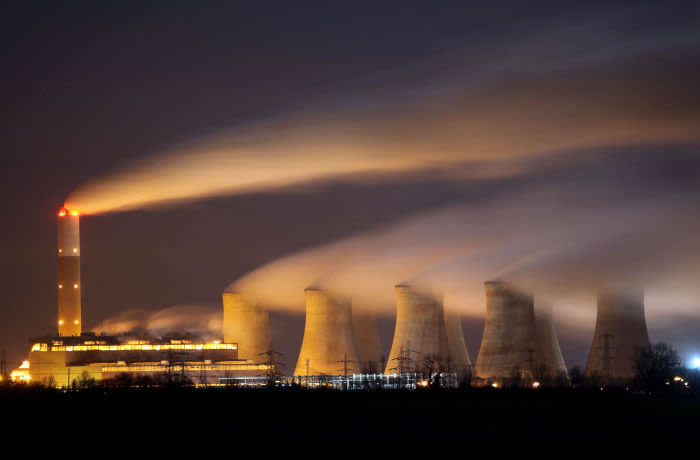
The fate of Aberthaw is a harbinger of what is to come up as the Great britain — one time the globe's largest coal consumer — prepares to end its addiction to the planet's most polluting fossil fuel. It is one of only 5 operational UK coal-powered stations subsequently Cottam in Nottinghamshire was closed on Monday after 50 years. Past adjacent summer only 3 will remain.
For those employed at the plants, the closures volition be devastating. But for environmentalists it will be some other victory in their global fight against coal power which is withal the globe's biggest source of electricity — its use growing in developing economies such as China and India last year.
When Aberthaw opened in 1971, conventional coal and oil power plants accounted for 88 per cent of electricity supplied to the UK market. Last year coal's share had shrunk to just 5 per cent. And between April and June this twelvemonth it fell to an best low of just 0.half dozen per cent.

This accelerated turn down is explained partly by the government's decision to slap an death appointment on the industry, announcing in 2015 that it would stamp out coal power entirely within a decade.
Earlier this year, Britain clocked up its first fortnight without coal power since 1882. And since 2008, the United kingdom has cut the carbon content of its electricity generation at the fastest rate of 25 major economies, alee of Denmark, the The states and China, co-ordinate to Imperial College London and free energy consultancy E4tech.
Its transformation from coal powerhouse — as recently as 1960, coal mining employed more than than 600,000 people — to almost coal ability-free is hugely significant at a time when countries are grappling with how to meet the 2015 Paris climate deal to limit global warming to well below 2C. To accomplish this, global emissions of carbon dioxide should already be declining past iii per cent a year — but instead they are still ascension, reaching a record high in 2018.
The Eu is pushing for a bloc-wide target to cut net CO2 emissions to zero by 2050 — a target the UK committed to law this summertime. Yet some member states are still heavily reliant on the fuel. Poland, for example, still draws lxxx per cent of its electricity from coal-fired plants. And in Federal republic of germany, the biggest coal consumer and biggest power producer in the EU, coal accounted for just over a third of ability generation final year.

"The British experience shows that whatsoever country can actually practise it [terminate coal power], it's a question of putting the policies in place to do it," says Richard Black, director of the Energy & Climate Intelligence Unit, a UK ecology think-tank. "Had Germany decided to tackle coal offset rather than nuclear [which it has committed to phasing out by 2022], I call back Germany could be in a similar position to the Uk."
Less than an 60 minutes's bulldoze from Aberthaw, near the village of Felindre in South Wales, is a remote location hedged past dark-green fields and copse that offers a inkling to why coal is no longer the dominant fuel in Britain'due south power sector. Drax, a FTSE 250 power company, whose heritage is steeped in coal, has won consent from the authorities to build a natural gas plant at the rural location to help run into gaps in electricity need.
Since Britain'due south outset centralised natural gas plant was commissioned in 1991 the fuel, which is less polluting than coal, has go the biggest single contributor to power generation in the UK — accounting for almost 40 per cent in 2018.
"The nuance for gas in the 1990s is huge as far every bit the coal decline is concerned," says Richard Howard, inquiry director at Oxford-based consultancy Aurora. Past then, Great britain had a domestic offshore oil and gas industry in the Northward Sea offering plentiful supplies. And coal had already been phased out from other key parts of the economy. Steam trains had been replaced past diesel fuel. Homes, once heated by coal, were fitted with modern gas boilers.
In 1991, the EU lifted restrictions on the use of natural gas for power generation. The move proved a catalyst and came simply 12 months after Britain'due south electricity system had been privatised, leading the newly private enterprises to build gas-fired power stations that had lower capital costs than coal.
Josh Burke, policy fellow at the Grantham Inquiry Institute on Climatic change and the Surroundings, says a "confluence of market drivers and regulatory interventions" have worked together since the plough of the decade to push button coal off the arrangement.
European and domestic legislation to tackle emissions have ensured that coal plants have become increasingly uneconomic to run, or build. In the UK, no new coal plants tin be constructed without expensive carbon capture and storage technology.
Mr Burke cites 2013 as a particularly critical turning point, when the United kingdom of great britain and northern ireland became the first country in the Eu to introduce a carbon cost support, a taxation paid by companies that generate electricity from fossil fuels, which severely weakened the investment example for coal. The tariff, priced at £18 a tonne of carbon dioxide, was designed to top up Europe's emissions trading arrangement, through which free energy companies buy permits to emit carbon.
"The moment the carbon price went up, coal went downwardly dramatically," says Mr Burke. "It tipped the economics in favour of natural gas."
Drax's main power station covers a 2,500 acre site about the North Yorkshire town of Selby. The largest power establish in the United kingdom, it was also the biggest polluter in western Europe. In one case run exclusively on coal, four of the found's half dozen generating units take been converted to biomass — burning forest pellets to produce energy.
Last year, renewables, including biomass, produced a third of the electricity generated in the UK. Past 2030, ministers desire thirty gigawatts — a tertiary of all electricity — to exist sourced from offshore air current alone.

Once built, renewables such as air current and solar have depression running costs. When generating, they come outset in the so-called merit club — a sequence that dictates how need for electricity is met by which source of supply. The most cost-efficient sources take priority. Coal, which has high marginal costs of product, has been pushed downwards the order to the point where it is rarely needed, particularly as free energy demand has fallen in recent years helped by more energy efficient appliances. Low gas prices compared to coal take likewise played a part.
"If I were a betting man", says Will Gardiner, Drax chief executive, "the likelihood that nosotros might run [coal] past 2023 is extremely low."
Critics of UK energy policy, all the same, cite a recent coma in England and Wales to argue that the electricity system has become as well reliant on intermittent sources of supply such equally solar and wind, which are vulnerable to irresolute weather condition atmospheric condition and rapid falls in output compared to traditional coal and gas plants that have longer to irksome down and therefore act equally a brake on the system.
Just, says National Grid, the visitor in charge of matching electricity supply and demand in Britain, while the complexity of the electricity organisation has increased "so have the tools and the resources that have become bachelor to manage information technology", such every bit batteries that reply rapidly to help smooth out any volatility.

Renewables are at present second only to gas in terms of power generation in the UK. Nuclear is responsible for a further 19.v per cent. Although Britain is building a new nuclear power station at Hinkley Point — the price of which has risen by well-nigh £3bn — all merely one of the country's current reactor fleet will take to be retired by 2030.
A government white paper — which the industry and environmentalists had hoped would show how the Uk planned to reduce emissions while also satisfying increased need for electricity — was delayed shortly before Boris Johnson became prime number government minister in July.
Kwasi Kwarteng, who became free energy minister in July, says that the government doesn't see the state's reliance on gas equally a "problem", citing its potential apply in the manufacture of hydrogen, considered a cleaner fuel, although he adds: "Obviously nosotros take to take clean gas."
A century ago, coal mining employed 1.2m people in United kingdom of great britain and northern ireland. At present, just a handful of producers remain — a decline that has come to be symbolised past the pit closures that triggered the 1984-85 miners' strike. In 2018, United kingdom of great britain and northern ireland coal production, down by 95 per cent since the 1950s, savage to but ii.6m tonnes.
Nonetheless even when United kingdom quits coal power generation, heavy industry volition still need the fossil fuel to manufacture products including steel and cement. The bulk of that demand is met from imports. In the first iii months of 2019, the UK imported two.6m tonnes of coal; the biggest single source was Russia. Indigenous production was just 592,000 tonnes.

U.k. producers, such every bit the County Durham-based Banks Group, contend the land's remaining demands should be met by domestic supply and are still trying to open new mines but are frequently faced by environmental opposition. Otherwise, they argue, the country is forgoing both economic do good and command over environmental standards.
"The Britain currently needs between 5m and 6m tonnes of coal just to continue supplying a range of essential industries, including steel and cement manufacturing," says Mark Dowdall, surround and community director at The Banks Group. "Effectually 80 per cent of the Great britain'due south need for coal is currently met through imports, increasingly from the The states and particularly Russia, and the greenhouse gas emissions of importing dress-down from these countries is significantly college than producing it in the United kingdom of great britain and northern ireland."
In March, the UK's starting time deep coal mine for more than thirty years was given the get-ahead by Cumbria canton council in north-due west England. The £180m Woodhouse colliery, on a coastal site in West Cumbria, is scheduled to open in 2022 and will produce 2.4m tonnes of coal a year for use in both the domestic and European steel industry.
In the longer-term, heavy industrial users know they as well will take to find substitutes for coal yet they warn solutions are nevertheless a way off. Inquiry into alternatives needs time, finance and UK regime support. "Ultimately, making steel and emitting carbon isn't acceptable; nosotros have to bite the bullet on this," says Chris McDonald, chief executive of the Materials Processing Institute, an industrial enquiry centre with close steel manufacture links. "It'southward no good saying we'll tax the carbon to death because and so you'll merely kill the manufacture in the United kingdom and the carbon will however be emitted somewhere else in the earth."
UK Steel, a merchandise association, says that in 2018 the country made seven.3m tonnes of crude steel. Of this, 5.7m tonnes was made via the basic oxygen steel furnace procedure which needs coking coal to drive oxygen out of iron ore to create steel used in sectors from construction to automotive and aerospace.
Steelmakers believe carbon capture usage and storage, could be an option to run across decarbonisation demands but it is far from a quick fix. Mr Kwarteng concedes that the regime has "dragged its feet" in the area.
Mr Glover sees what is happening at Aberthaw as a mirror for the changes taking identify across Europe every bit information technology tries to cutting carbon from its economic system. "It is quite a good microcosm for how the shift works," he says. He points out how challenging these changes are for employees, particularly in areas that are already economically depressed. "It'southward the hardest thing in the energy transition," he adds. "We've got a lot of staff . . . we've got responsibilities to the communities that nosotros are in."
Back in his Swindon office, Mr Glover has two pictures of Aberthaw on the wall. One shows him standing on tiptop of the coal pile, while the other is a dusk shot of the power station. "It will stay on my wall when I put my wind farms up likewise," he says.
Timeline
Coal production in U.k.

1913
Coal production in Britain peaks at 287m tonnes
1921
Employment in the coal mining manufacture peaks at 1.25m people
1984-85
National miners' strike (earlier strikes too took place in 1971 and 1974)
2015
The UK becomes the first national government to commit to phasing out coal power, setting a date of 2025; Britain'south final deep coal mine closes
2016
Showtime total mean solar day without turning on coal-fired power stations since 1882
2019
Offset coal ability-gratuitous fortnight
Letter of the alphabet in response to this article:
How Thatcher helped the United kingdom of great britain and northern ireland drive down emissions / From Carlo Stagnaro, Milan, Italy
Source: https://www.ft.com/content/a05d1dd4-dddd-11e9-9743-db5a370481bc
0 Response to "Why Did the Decline of the Coal Stop Around 1960 and Then We Increased Its Use Again"
Post a Comment